
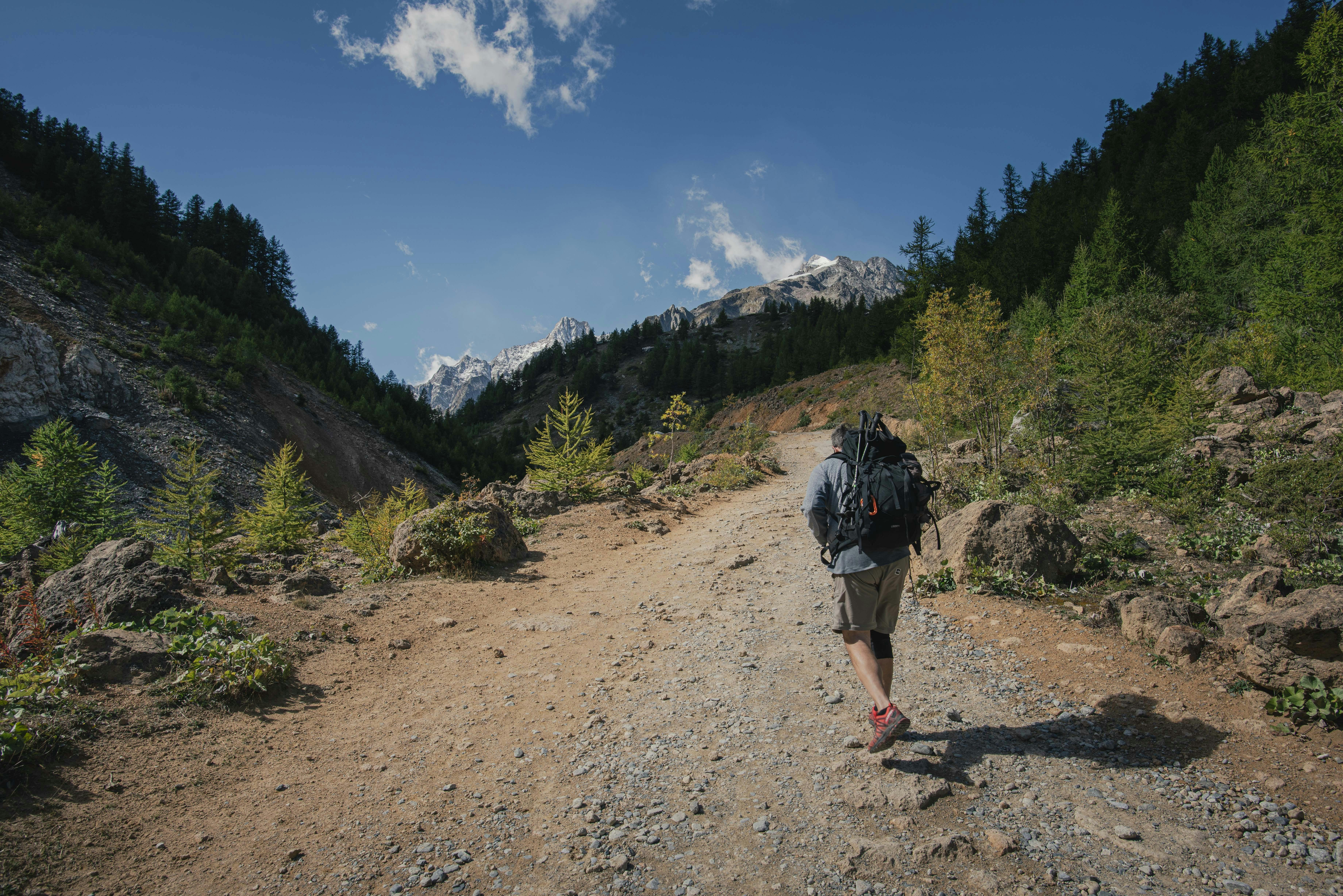
Two walkers of equal fitness on the same trail can cover very different distances, and pack weight explains more of that gap than pace or determination. The relationship is not proportional.
Energy cost rises faster than the load
Carrying weight increases the energy required for each step, but not by a simple ratio. Beyond a modest fraction of body weight, the cost per additional kilogram climbs.
Gradient amplifies this, because on a climb the load is being lifted vertically as well as carried forward. A heavy pack is disproportionately expensive uphill.
Since most trails are decided by their climbs rather than their flat sections, the penalty lands precisely where the walker has least capacity to absorb it.
Gait changes before fatigue does
A loaded walker leans forward, shortens the stride and reduces the swing of the arms, which lowers efficiency further and shifts effort onto smaller stabilising muscles.
Balance corrections increase on uneven ground, since a high or badly packed load moves the centre of mass and every step requires more adjustment.
Those adjustments accumulate. By late afternoon foot placement degrades, which is when most slips and ankle injuries on descents occur.
Weight on the feet costs more than weight on the back
Load carried on the foot is lifted and accelerated with every stride, so it costs several times more energy per unit than the same mass in the pack.
This is the reasoning behind lighter footwear on trails that do not demand heavy boots, and why spare footwear is one of the first items dropped.
Poles shift a share of the load to the arms and reduce the force through knees on descent, which matters more as the pack gets heavier.
Base weight is where the savings are
Consumables like food, water and fuel are set by the trip and cannot be cut far without risk. Base weight, meaning everything else, is where reduction happens.
The largest items dominate: shelter, sleeping system and pack itself. Trimming those three usually achieves more than eliminating a long list of small objects.
Water is the exception worth managing actively, since it is heavy and often available en route. Carrying between sources rather than carrying a full day's supply saves real weight.
Light has a floor
Reducing weight past the point where shelter, insulation and navigation are adequate converts a comfort saving into an exposure risk, and mountain weather punishes that quickly.
Skill substitutes for equipment only up to a point, and the point moves with conditions, season and how remote the route is.
The sensible target is the lightest kit that still handles the worst conditions the route can plausibly produce, which is a different number for every trip.