
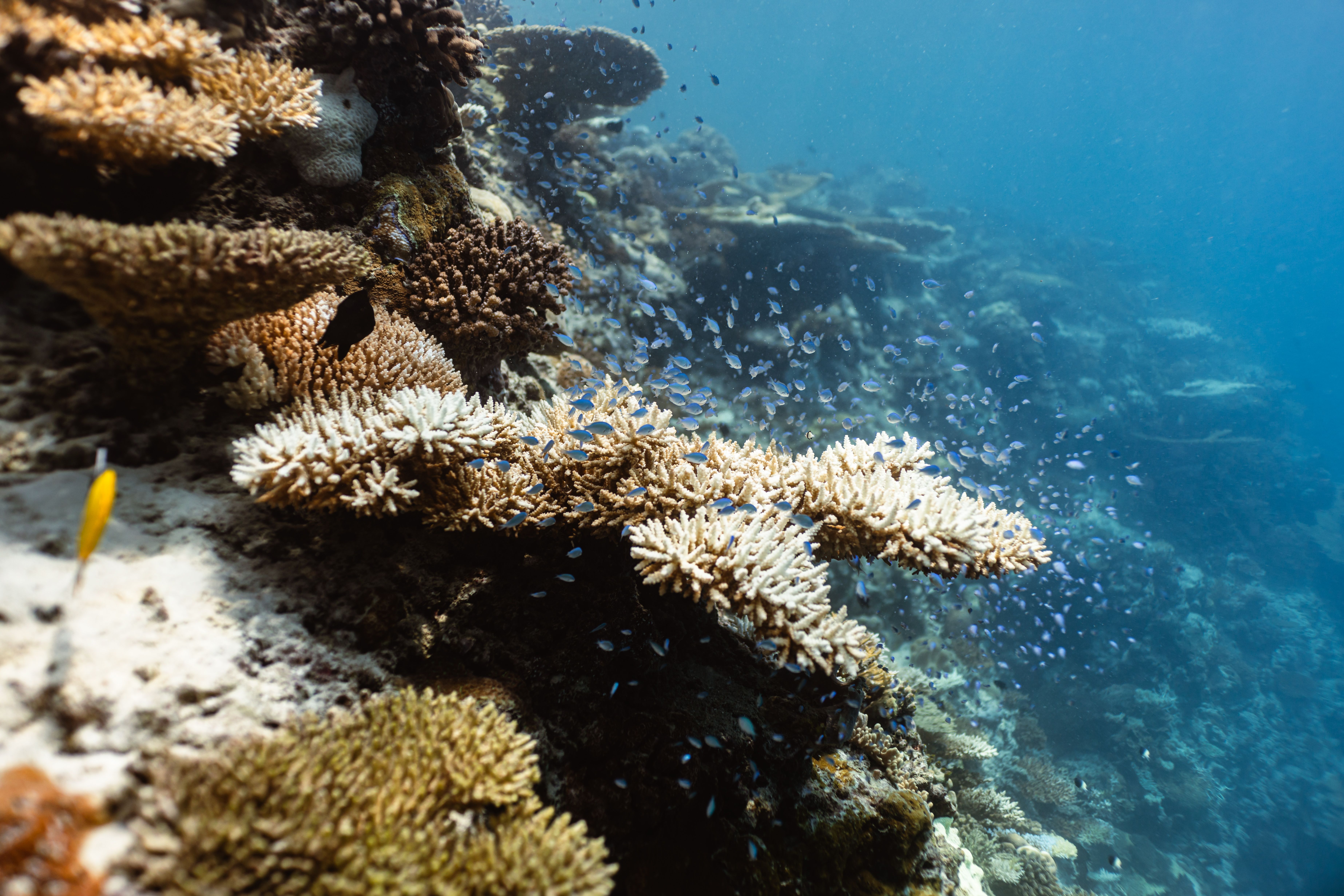
A bleached reef is white because the coral has expelled something, not because it has died. Understanding what was expelled explains both the cause and the possibility of recovery.
Coral depends on a resident partner
Reef-building corals are animals that host single-celled algae within their tissues, and those algae photosynthesise, passing most of the resulting energy to the coral.
The arrangement is what allows reefs to grow in clear tropical water that carries very few nutrients, since the coral is effectively farming its own food supply.
The algae also provide the colour. Coral tissue itself is largely transparent over a white calcium carbonate skeleton.
Heat breaks the photosynthetic machinery
When water temperature rises beyond the coral's normal range, photosynthesis in the algae becomes unstable and begins producing damaging reactive compounds.
The coral responds by expelling the algae, which removes the source of the damage and also removes its main energy supply and its colour.
The threshold is narrow. Sustained temperatures only slightly above the usual summer maximum are enough, which is why bleaching tracks marine heatwaves closely.
Bleached coral is starving, not dead
A bleached colony remains alive and can survive for a period on stored reserves and by capturing plankton directly.
If the water cools within weeks, algae can recolonise the tissue and the colony regains colour and function, though growth and reproduction are set back.
Prolonged heat exhausts the reserves and the colony dies, after which the skeleton is colonised by algae and erodes rather than being rebuilt.
Recovery time is the limiting factor
A reef rebuilding after severe mortality depends on larvae from surviving colonies settling and growing, which takes many years for the slow-growing structural species.
When severe heat events recur at intervals shorter than that recovery period, the reef never returns to its previous structure.
Shortening intervals between events, rather than the severity of any single one, is what changes reef trajectories over decades.
Local pressures set the starting condition
Nutrient runoff, sedimentation, destructive fishing and physical damage all reduce a reef's ability to recover between heat events.
Reefs with intact herbivorous fish populations recover better, because grazing keeps algae from occupying the space where coral larvae would settle.
This is the part local management can influence, which is why marine protection and water quality work continue even though the primary driver is ocean temperature.