
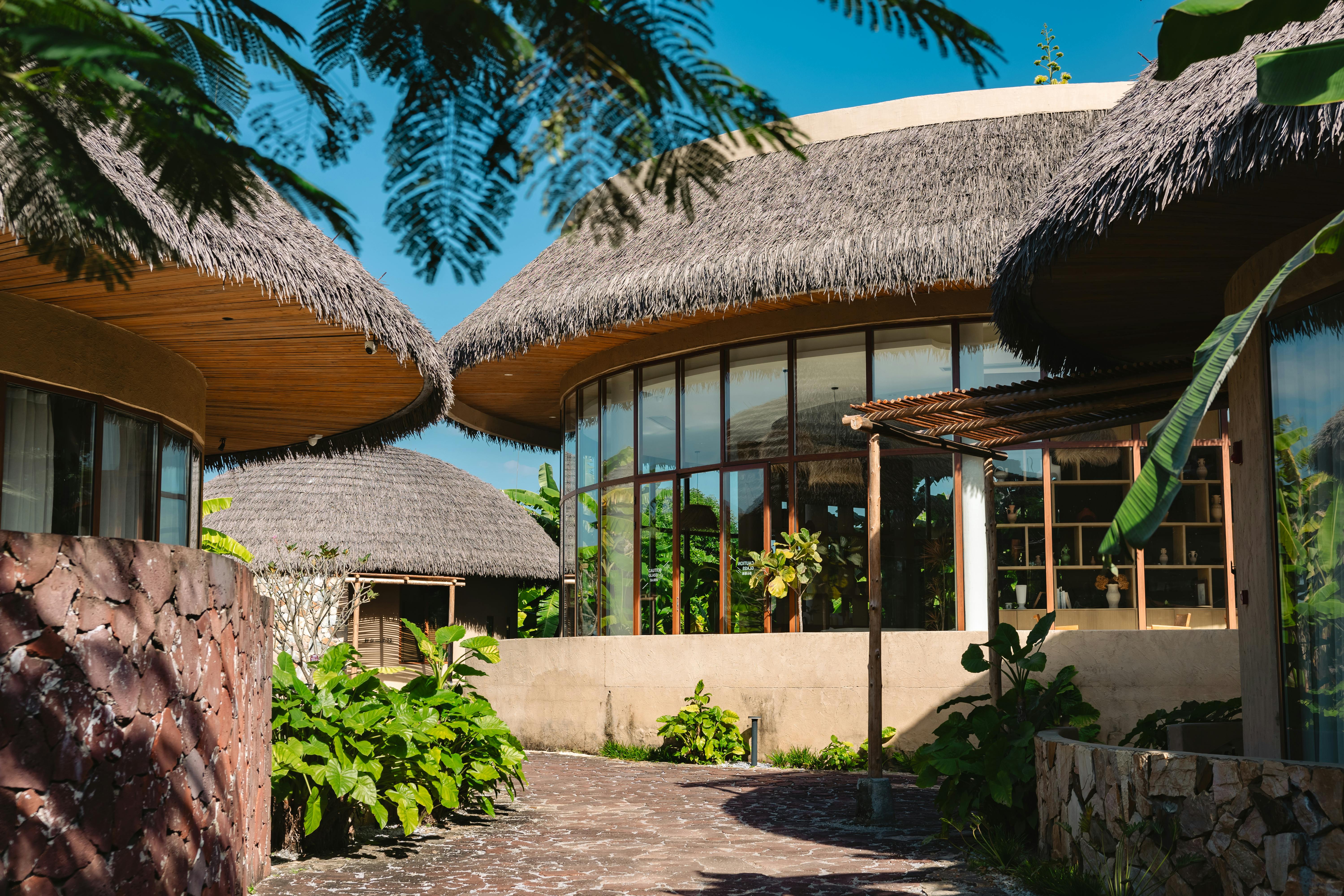
Remote eco lodges rarely exceed a couple of dozen rooms, and the limit is usually fixed before the first foundation is poured. The constraint comes from the site itself rather than from a marketing decision.
The site sets the ceiling
A lodge away from municipal services has to produce its own power, draw its own water and treat its own sewage. Each of those systems has a capacity that is expensive to expand later.
The scarcest of them decides the room count. If the spring or borehole yields a fixed volume a day, that volume divided by realistic guest consumption gives the maximum number of beds.
Building beyond that number does not simply strain the system. It forces trucked-in water or a second generator, which reverses the reason the lodge was sited there at all.
Waste treatment is the harder half
Supplying water is a solved problem compared with disposing of it. Septic fields and reed beds need land area, soil depth and distance from any watercourse.
Those requirements scale with occupancy, and suitable ground is often the smallest patch on the property. A lodge in a floodplain or on thin rocky soil has very little room to work with.
When treatment capacity is exceeded, the failure is not gradual. Effluent surfaces or reaches groundwater, and the damage lands on the ecosystem the guests came to see.
Access limits everything upstream
Materials for construction and supplies for operation arrive along whatever track exists. A larger lodge needs a wider, harder road, and roads fragment habitat more reliably than buildings do.
Staff have to reach the site too, daily or on rotation. Housing them locally adds to the same water and waste totals that already constrain the guest count.
So the road is often deliberately left rough. It caps vehicle size, which caps delivery volume, which caps how large the operation can become.
Wildlife tolerance is a real number
Animals adjust to a predictable level of human presence and stop adjusting past a threshold. Nesting birds abandon sites, and larger mammals shift their movement to avoid a corridor entirely.
Operators who depend on sightings learn where that threshold sits on their own land, usually by watching what happens in a busy season.
Room count is the lever they have. Reducing it lowers vehicle movements, lighting hours and noise together, because all three scale with occupancy.
Small is a cost structure, not a luxury
Fewer rooms spread fixed costs across fewer nights, so the nightly rate rises. That is arithmetic rather than positioning.
It also changes staffing. A small lodge cannot run departmental shifts, so staff cover several roles and are retained year-round rather than hired seasonally.
The result reads as intimacy to a guest, but it started as a supply calculation about water, soil and road width.